Knee Replacement Recovery Navigator
Select a recovery phase below to understand what to expect, why it happens, and how to manage it.
The Shock
Pain Peak
Mental Wall
Physical Grind
You just woke up from anesthesia. The room is bright, your leg feels like it belongs to someone else, and there’s a heavy bandage wrapped around your new joint. You’re probably asking yourself one question: Is today going to be the worst part?
Here is the truth that most surgeons won’t say in the first five minutes of discharge: There isn’t one single "hardest day." It’s more like a series of hurdles. For some people, Day 1 is brutal because of the shock. For others, Day 3 or Week 2 hits harder when the adrenaline wears off and reality sets in. But if you look at patient reports and clinical data, there is a clear pattern to where the pain spikes and where the mental fatigue kicks in.
The Immediate Shock: Days 0 to 1
For the vast majority of patients, the first 24 hours are physically intense but mentally manageable. Why? Because you are still under the influence of long-acting nerve blocks and residual anesthesia. You might feel a deep ache, but it’s often muffled. The real challenge here isn’t pain-it’s logistics.
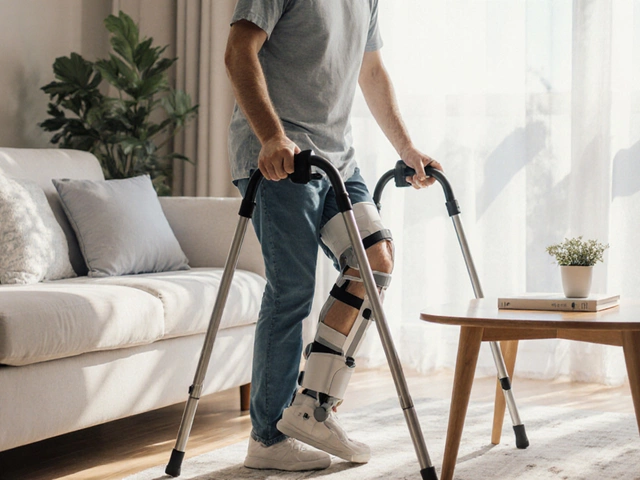
Day 0 (the day of surgery) and Day 1 are about survival mechanics. You’ll likely have a urinary catheter removed within 12-24 hours. If you haven’t urinated on your own, you might need a temporary re-insertion, which is uncomfortable. Then comes the first attempt at standing. Nurses will push you to get out of bed within four hours of waking up. This is non-negotiable because it prevents blood clots.
What makes this phase hard:
- Mobility fear: Trusting your leg to hold your weight feels impossible.
- Nausea: Opioids used during surgery often cause stomach upset.
- Sleep deprivation: Hospital interruptions and discomfort make rest difficult.
If you’re wondering if you should panic, don’t. This phase is short-lived. The nerve block usually wears off between 12 and 24 hours, marking the transition to the next hurdle.
The Pain Peak: Days 2 to 3
This is where many patients report their lowest point. The nerve block has fully faded. The local anesthetics injected by the surgeon are gone. Now, your body is dealing with raw surgical trauma. Inflammation is peaking. Your knee is swollen, hot to the touch, and stiff.
Why does it hurt so much now? It’s not just the incision. During Knee Replacement surgery, the quadriceps tendon is often manipulated or partially detached to access the joint. This muscle group controls straightening your leg. When it spasms against the swelling, it creates sharp, electric-shock-type pains.
Many people think they did something wrong because the pain is worse than yesterday. They didn’t. This is normal physiology. The key here is aggressive pain management. Don’t wait until you’re crying to take your meds. Stay ahead of the curve.
| Timeframe | Primary Sensation | Main Challenge | Action Required |
|---|---|---|---|
| Day 0-1 | Dull ache, numbness | Getting out of bed | Use walker, ice frequently |
| Day 2-3 | Sharp, throbbing pain | Pain management & sleep | Stay on schedule with meds |
| Week 1 | Stiffness, tightness | Physical Therapy exercises | Focus on range of motion |
| Week 2-4 | Aching, fatigue | Mental endurance | Consistency over intensity |
The Mental Wall: Week 2
Surprisingly, many patients find Week 2 harder than Week 1. By now, you’re home. The hospital nurses aren’t checking on you every hour. You’re alone with your pain and your progress-or lack thereof.
This is the "Valley of Despair." The initial excitement of being discharged has worn off. You’ve been doing the same exercises-heel slides, quad sets, ankle pumps-for seven days. Your knee still doesn’t bend past 90 degrees easily. Walking feels clumsy. You might feel like you’re stuck.
This psychological dip is real. Studies on post-operative depression show that anxiety peaks around days 10-14. You start questioning if the surgery was worth it. Is this how life will be forever? No. But your brain needs reassurance.
Tips to survive Week 2:
- Track small wins: Did you bend 5 degrees more than last week? That’s progress.
- Limit social media: Seeing others run marathons while you struggle to put on socks can be toxic right now.
- Ask for help: Don’t try to shower or cook alone if you’re dizzy from meds.

The Physical Grind: Weeks 3 to 6
Once you pass the two-week mark, the acute pain subsides into a dull, constant ache. This is the phase of persistence. You’re no longer fighting inflammation; you’re fighting stiffness.
Your scar tissue is forming. If you don’t stretch it, it locks your knee down. This is why Physical Therapy is critical during weeks 3-6 to prevent arthrofibrosis (excessive scar tissue formation). Many patients skip PT sessions because they feel "okay," only to regret it later when their range of motion plateaus.
During this time, you’ll notice that evenings are worse. Gravity pulls fluid into your leg all day, causing evening swelling. Elevating your leg above heart level for 30 minutes before bed can save your sanity.
Factors That Change Your Timeline
Not everyone experiences the "hardest day" at the same time. Several variables shift the difficulty curve:
- Pre-surgery fitness: Patients who strengthened their quads before surgery (pre-habilitation) often report less pain in Days 2-3. Strong muscles support the joint better.
- Pain tolerance: People with chronic pain conditions (like fibromyalgia) may experience a prolonged peak.
- Support system: Having a dedicated caregiver reduces stress, which directly lowers perceived pain levels.
- Complications: Minor issues like wound drainage or infection signs can reset your clock, making any day potentially the hardest.
It’s also worth noting that bilateral replacements (both knees at once) are significantly harder in the first week. You have no "good leg" to lean on. Most surgeons recommend staggering these surgeries unless the patient is exceptionally fit.

How to Manage the Hardest Moments
Since you can’t predict exactly which day will break you, prepare for the worst-case scenario. Here is a practical toolkit for managing the peak pain days:
- Ice is your best friend: Use cryotherapy devices or ice packs for 20 minutes on, 40 minutes off. Never apply ice directly to skin.
- Medication timing: Set alarms. Taking pills 30 minutes before therapy helps you perform better.
- Breathing techniques: When pain spikes, tensing up makes it worse. Practice diaphragmatic breathing to relax the surrounding muscles.
- Distraction: Binge-watch a series or listen to audiobooks. Focusing on the pain amplifies it.
Remember, pain is subjective. What feels unbearable to one person might be manageable to another. Compare yourself only to your previous self, not to your neighbor who had surgery last year.
When to Call Your Doctor
While hardship is expected, certain symptoms signal trouble. Don’t tough it out if you experience:
- Fever over 101°F (38.3°C).
- Redness spreading away from the incision site.
- Calf pain that doesn’t go away with elevation (possible DVT).
- Inability to bear weight on the leg suddenly.
- Uncontrolled pain despite medication.
These signs require immediate attention. Otherwise, trust the process. The hardest day is temporary. The relief is permanent.
How long does severe pain last after knee replacement?
Severe, acute pain typically lasts for the first 3 to 7 days. After the first week, the sensation shifts from sharp pain to stiffness and soreness. Most patients transition from opioids to over-the-counter anti-inflammatories by the end of the second week.
Is day 2 really the worst day after knee replacement?
For many patients, yes. Day 2 or 3 is often reported as the most painful because the nerve block has worn off, but the body's inflammatory response is still at its peak. However, some patients find the mental fatigue of Week 2 harder to handle.
Can I walk on the first day after knee replacement?
Yes, and you should. Most protocols require you to stand and take a few steps with a walker within 4 to 6 hours after surgery. Early mobilization reduces the risk of blood clots and speeds up recovery.
Why is my knee so stiff in the morning?
Fluid accumulates in the joint overnight due to gravity and inactivity. This causes swelling and tightness. Gentle warm-up exercises and heat application before getting out of bed can help loosen the joint.
How soon can I drive after knee replacement?
If you had surgery on your right knee, you typically cannot drive for 4 to 6 weeks. If it was your left knee and you drive an automatic car, you might be cleared as early as 2 weeks, provided you are off opioid painkillers and have adequate reaction times.