
Bone Loss Estimator
Estimate your jawbone loss based on time since tooth loss. This is an approximation only—professional evaluation is required for actual implant eligibility.
Estimated Bone Loss
Many people wait too long to replace a missing tooth. They think, It’s just one tooth, or I can live with it, or It’s too late now. But here’s the truth: dental implants can still work-even after years of missing teeth-if your jawbone and gums are healthy enough. The real question isn’t how long you’ve waited. It’s what condition your mouth is in today.
Why Timing Matters More Than You Think
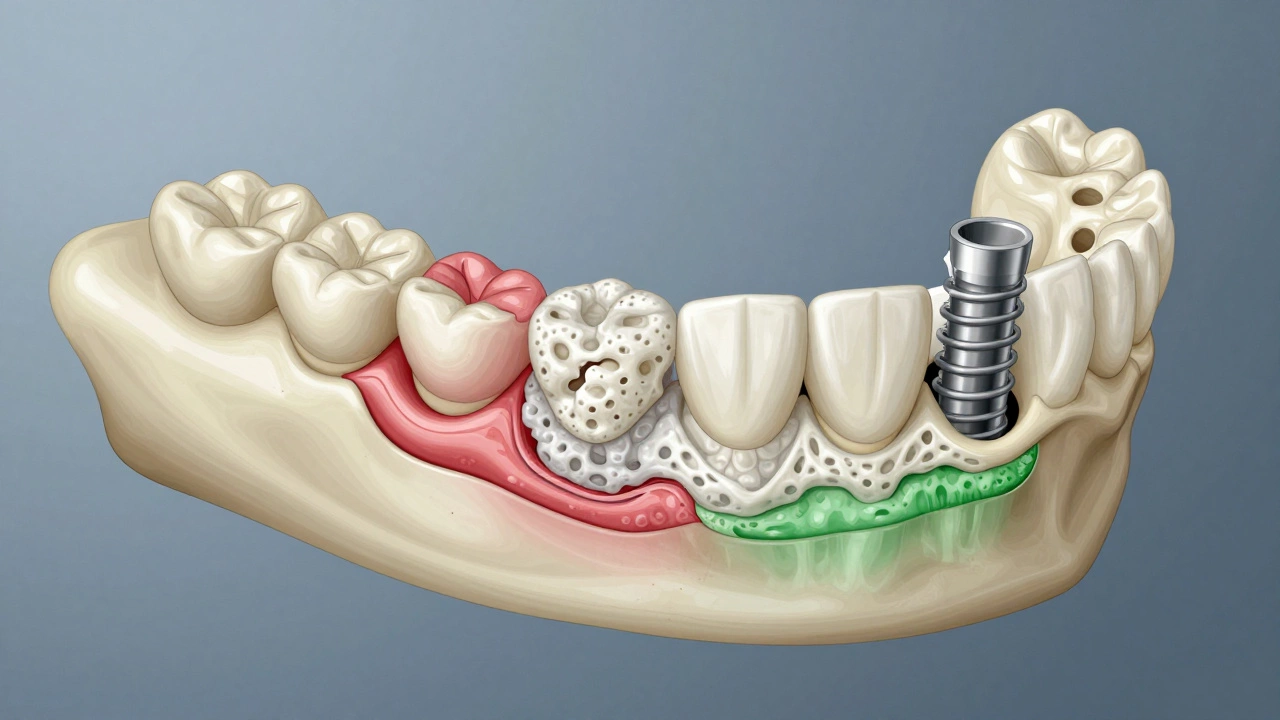
When you lose a tooth, your jawbone doesn’t just sit still. It starts to shrink. This process, called bone resorption, begins within weeks. After one year, you can lose up to 25% of the bone volume in that area. After five years? Up to 60%. That’s not just a number-it means your jaw loses the structure needed to hold an implant securely.
Think of your jawbone like a tree root. If the root decays, the tree falls. Same with teeth. No tooth = no stimulation = bone melts away. Without enough bone, implants can’t be placed. Or worse-they fail later because they’re not anchored properly.
But here’s what most people don’t know: bone loss doesn’t mean you’re out of options. It just means you might need extra steps before the implant goes in.
What Makes It ‘Too Late’? The Three Deal-Breakers
There are only three real reasons someone can’t get dental implants. Everything else can be fixed.
- Severe bone loss-Your jawbone is too thin or too short to support an implant. This is the most common issue after years without teeth.
- Untreated gum disease-Active infection around remaining teeth or in the implant site will kill the implant before it even heals.
- Uncontrolled systemic diseases-Diabetes, osteoporosis, or autoimmune conditions that aren’t managed well can interfere with healing.
If you have any of these, implants aren’t impossible-they’re just delayed. And that’s okay.
Can You Still Get Implants After Years Without Teeth?
Yes. Absolutely.
I’ve seen patients come in who lost teeth 15, 20, even 30 years ago. Their jaws were thin. Their gums were sore. But after a 3D scan and a treatment plan, we moved forward. How? With bone grafting.
Bone grafting isn’t magic. It’s science. Surgeons add bone material-either from your own body, a donor, or synthetic sources-to rebuild the missing structure. After 4 to 6 months of healing, the new bone fuses with your jaw. Then, and only then, do we place the implant.
One patient, a 68-year-old woman from Koramangala, lost all her lower teeth in her 40s. She wore dentures for 25 years. Her jawbone was barely 3mm thick. We did a block graft using her own chin bone. Eight months later, she got four implants. Today, she eats apples again. No slipping. No glue. No embarrassment.
Age isn’t the barrier. Bone health is.
What About Gum Disease?
If you have red, swollen, bleeding gums-or worse, teeth that are loose-you can’t jump straight to implants. First, you must treat the infection.
Gum disease doesn’t just hurt your gums. It eats away at the bone holding your teeth in place. If you place an implant into infected tissue, it will fail. Period. Studies show implant failure rates jump from under 5% to over 30% when gum disease is untreated.
Successful treatment means:
- Deep cleaning (scaling and root planing)
- Antibiotics if needed
- Regular maintenance cleanings every 3-4 months
- Stopping smoking (yes, it’s that big a deal)
Once your gums are healthy and stable for at least 3 months, you’re a candidate again.
Medical Conditions That Can Delay Implants
Diabetes? Osteoporosis? Heart disease? These don’t automatically disqualify you. But they do require careful planning.
For example: someone with well-controlled Type 2 diabetes (HbA1c below 7%) has the same implant success rate as someone without diabetes. But if their blood sugar is consistently above 8%, healing slows. Infections become more likely.
The same goes for osteoporosis medications like bisphosphonates. Long-term use can increase the risk of jawbone complications. But if your doctor knows you’re planning implants, they can adjust your treatment or pause the meds temporarily.
Always tell your dentist about every medication you take-even vitamins and supplements. No guesswork. No hiding.
What If You’ve Been Wearing Dentures for Years?
Dentures aren’t the enemy. But they’re not a long-term solution either.
Over time, dentures press down on your gums and jawbone. This accelerates bone loss. That’s why many long-term denture wearers end up with sunken cheeks, a weak jawline, and difficulty eating hard foods.
Implants can change that. Even if you’ve worn dentures for decades, you can still get implant-supported dentures. These snap onto 4-6 implants and stay put. No more slipping at dinner. No more adhesives. No more avoiding social events because you’re afraid your teeth will fall out.
In Bangalore, many patients choose this route. It’s called All-on-4 or All-on-6. It’s not cheap, but it’s life-changing. And it’s still possible even if your bone is thin-because we combine it with bone grafting when needed.
How Do You Know If You’re Still a Candidate?
There’s only one way to find out: get a 3D scan.
A regular X-ray won’t cut it. You need a CBCT (cone beam computed tomography) scan. It shows your jawbone in 3D-its height, width, density, and shape. It tells us exactly how much bone you have left and where.
After the scan, your dentist will tell you:
- Can implants be placed now?
- Do you need bone grafting?
- Do you need gum treatment first?
- How long will the whole process take?
Most people assume the answer is no. The scan often says yes.

What’s the Worst That Can Happen If You Wait?
Waiting doesn’t just mean more missing teeth. It means:
- More bone loss → more expensive procedures
- More difficulty eating → poor nutrition
- Shifting teeth → bite problems
- Sunken face → looking older than you are
- Lower self-confidence → avoiding smiles, photos, conversations
One study from the Journal of Oral Implantology found that people who waited more than 5 years after tooth loss had 3 times the cost of treatment compared to those who acted within 12 months. Not because implants cost more. But because they needed bone grafts, sinus lifts, and multiple surgeries.
Delaying doesn’t save money. It just shifts the cost to later.
What If You’re Not Sure?
Don’t assume. Don’t guess. Don’t listen to well-meaning friends who say, ‘You’re too old’ or ‘It’s too late’.
Book a consultation. Bring your X-rays. Ask for a CBCT scan. Ask about your bone density. Ask about grafting options. Ask how long it’ll take. Ask about payment plans.
Most clinics in Bangalore offer free initial consultations. No pressure. No sales pitch. Just facts.
And if you’re told you’re not a candidate? Get a second opinion. Not every dentist has the same tools or experience. A specialist in implant dentistry might see options your general dentist doesn’t.
Bottom Line: It’s Never Too Late-If You’re Willing to Act
Dental implants aren’t just about replacing teeth. They’re about restoring function, confidence, and quality of life. Bone loss? Fixable. Gum disease? Treatable. Age? Just a number.
The only thing that makes it too late is giving up.
If you’ve lost teeth-even decades ago-you still have options. The clock isn’t ticking on your eligibility. It’s ticking on your comfort, your health, and your smile. And it’s never too late to turn it back.