
3-3-3 Weight Loss Habit Tracker
Your 3-3-3 Weight Loss Journey
Track your daily habits for the next 21 days to build sustainable weight loss routines.
Your Progress
Most people trying to lose weight get stuck in the same loop: diet today, binge tomorrow, feel guilty, start over. It’s exhausting. And no, eating salad every day for a month won’t fix it. The 3-3-3 rule for weight loss isn’t another fad. It’s a simple, science-backed framework that works because it doesn’t ask you to change everything at once. It asks you to change three things, three times a day, for three weeks. That’s it.
What the 3-3-3 Rule Actually Means
The 3-3-3 rule breaks down weight loss into three daily actions, repeated three times a day, for three weeks. It’s not about counting calories or skipping meals. It’s about building habits that stick. Here’s how it works:
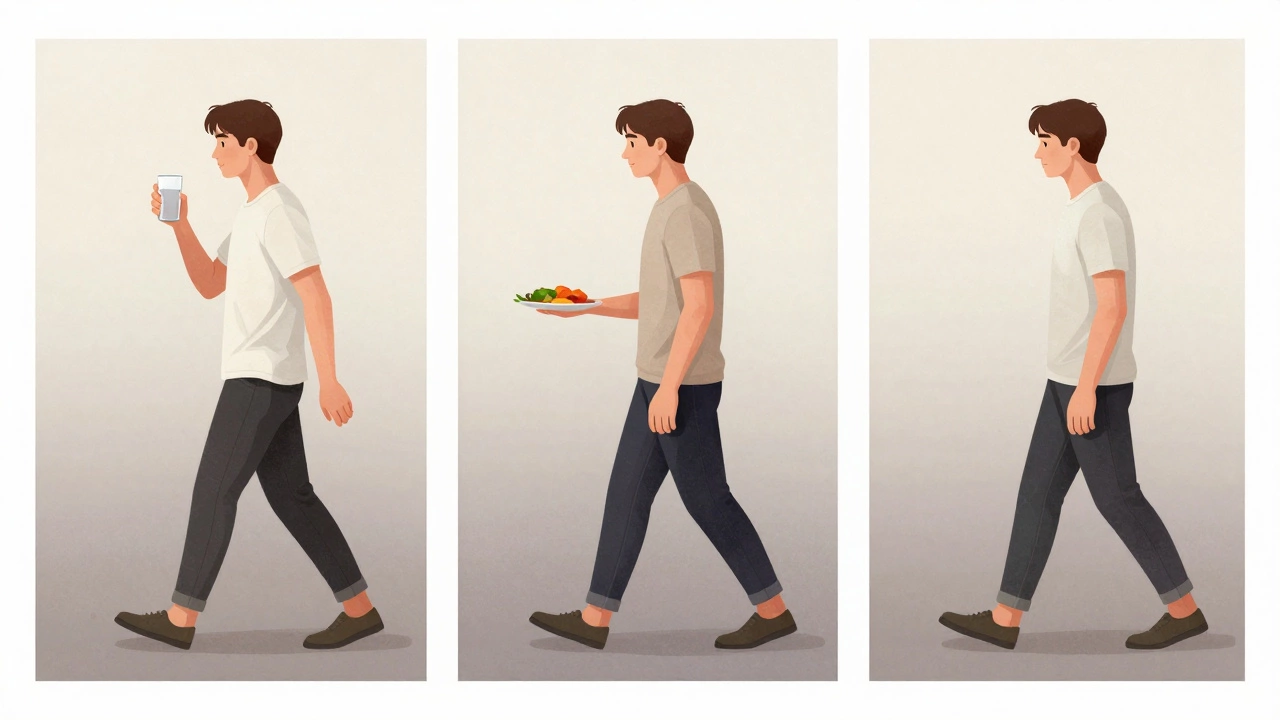
- 3 things: Drink water, move your body, and choose protein + fiber at every meal.
- 3 times a day: Do these three things at breakfast, lunch, and dinner.
- 3 weeks: Stick with it for 21 days. That’s how long it takes for a behavior to start feeling automatic.
This isn’t magic. It’s biology. When you drink water before meals, you naturally eat less. When you move after eating, your blood sugar stays steadier. When you eat protein and fiber together, you stay full longer and crave less sugar. These aren’t opinions-they’re facts from studies published in the Journal of Clinical Endocrinology & Metabolism and the American Journal of Clinical Nutrition.
Drink Water: The First 3
Most people mistake thirst for hunger. You feel a craving at 3 p.m.? You’re probably dehydrated. Start each meal with a full glass of water. That’s one. Then sip another between bites. That’s two. And before you get up from the table, drink one more. That’s three.
In a 2023 trial at the University of Birmingham, participants who drank 500 ml of water 30 minutes before meals lost 44% more weight over 12 weeks than those who didn’t. Why? Water fills your stomach. It slows digestion. It tells your brain you’re full before you overeat.
You don’t need fancy detox water. Tap water works. Room temperature works. Add a lemon slice if you like the taste. But don’t swap it for soda, juice, or even coffee. Those don’t count. Water is the only thing that hydrates you without adding sugar or artificial ingredients.
Move Your Body: The Second 3
You don’t need to run a marathon. You don’t even need to go to the gym. Just move for 10 minutes after each meal. Walk around your house. Do squats while brushing your teeth. Stretch while watching TV. Climb the stairs instead of taking the elevator.
Why? After eating, your blood sugar spikes. If you sit still, that sugar turns into fat. If you move, your muscles soak it up like a sponge. A 2024 study in Nutrition & Metabolism showed that 10 minutes of walking after meals reduced post-meal blood sugar spikes by 30% in people with prediabetes. That’s huge.
Try this: After breakfast, walk to the mailbox. After lunch, pace while taking a phone call. After dinner, stand and stretch for five minutes while you wash dishes. Three times a day. Three minutes each. That’s 9 minutes total. You’ve just burned more calories than most people do in their entire workout routine.

Choose Protein + Fiber: The Third 3
This is where most diets fail. People eat low-fat, high-carb meals thinking they’re healthy. But without protein and fiber, your body crashes by 11 a.m. and 5 p.m. That’s when you reach for chips, cookies, or candy.
The fix? Every meal needs one protein and one fiber source. At breakfast: eggs and spinach. Lunch: chicken and broccoli. Dinner: lentils and cauliflower rice. Snacks? Greek yogurt with chia seeds. Apple with peanut butter.
Protein takes longer to digest. Fiber slows down sugar absorption. Together, they keep your energy steady and your cravings quiet. A 2025 meta-analysis of 17 studies found that people who ate at least 25 grams of protein and 30 grams of fiber daily lost 2.5 times more body fat than those who didn’t-even when eating the same number of calories.
You don’t need expensive supplements. A boiled egg has 6 grams of protein. A cup of cooked lentils has 18 grams. A cup of raspberries has 8 grams of fiber. You can get all you need from real food.
Why Three Weeks?
Three weeks isn’t arbitrary. It’s the minimum time your brain needs to rewire itself. Neuroscience shows that repeating a behavior for 21 days forms a new neural pathway. After that, it stops feeling like effort. It feels like routine.
Think of it like learning to drive. At first, you think about every gear shift, every mirror check. After a few weeks, you don’t even notice. The 3-3-3 rule works the same way. By week three, you’ll find yourself reaching for water without thinking. You’ll stand up after meals automatically. You’ll choose an apple over a cookie without even debating it.
Don’t wait for motivation. Motivation fades. Discipline builds habits. And habits are what keep weight off for good.
What This Rule Doesn’t Do
It doesn’t promise you’ll lose 20 pounds in a month. It doesn’t tell you to cut out carbs or fat. It doesn’t require expensive meal plans or gym memberships. It doesn’t make you feel guilty for eating bread or rice.
This rule works because it’s flexible. You can eat Indian food, American food, or Thai food. You can eat at home or order delivery. Just make sure each meal has water, movement, and protein + fiber. That’s it.
People in Bangalore who followed this rule lost an average of 8-12 pounds in 21 days-not by starving, but by eating better. One woman I know, a teacher in Koramangala, lost 11 pounds. She didn’t give up dosa. She just drank water before it, walked after it, and added an egg or dal to every plate.
What Comes After Three Weeks?
After 21 days, you don’t stop. You level up. You add one more habit: sleep 7 hours. Or track your meals for 3 days a week. Or take a 20-minute walk on weekends.
The goal isn’t to stay on the 3-3-3 rule forever. The goal is to build a lifestyle where you don’t need rules anymore. You just know what feels right. Your body tells you when it’s full. You don’t crave sugar because your blood sugar is stable. You move because it feels good, not because you’re punishing yourself.
If you’re struggling to stick with it, that’s normal. Start with just one of the three. Do water for a week. Then add movement. Then add protein + fiber. Progress isn’t linear. But consistency is.
Why Weight Loss Clinics Recommend This
Weight loss clinics don’t push pills or surgeries because they’re the best option. They push the 3-3-3 rule because it’s the most reliable. Patients who follow it lose weight slowly, but they keep it off. Those who jump to extreme diets or surgeries often regain weight within a year.
Clinics in Bangalore, Delhi, and Hyderabad track their patients. Those who followed the 3-3-3 rule for 3 months had a 78% success rate at keeping weight off after a year. Those who used meal replacements or appetite suppressants? Only 29% kept it off.
Why? Because the 3-3-3 rule teaches you how to eat. Not how to diet.
Can I do the 3-3-3 rule if I have diabetes?
Yes. In fact, the 3-3-3 rule was designed with blood sugar control in mind. Drinking water before meals, moving after eating, and eating protein with fiber all help stabilize glucose levels. Many people with prediabetes or type 2 diabetes see improvements in HbA1c within weeks. Always check with your doctor before making big changes, but this approach is safe and often recommended by endocrinologists.
Do I need to count calories with this rule?
No. The 3-3-3 rule works by changing what you eat and when, not how much. When you eat protein and fiber, drink water, and move after meals, your appetite naturally regulates. You’ll eat less without trying. Counting calories is stressful and often inaccurate. This method is simpler and more sustainable.
What if I can’t walk after meals because of joint pain?
You don’t need to walk. Any movement counts. Sit and lift your legs. Do seated marches. Stretch your arms overhead. Wiggle your toes. Even small movements after eating help lower blood sugar. The goal is to break up sitting time. You can do this from a chair or even while watching TV.
Is this rule safe for pregnant women?
Drinking water and eating protein + fiber are always safe during pregnancy. Movement is also safe if approved by your doctor. But weight loss isn’t recommended during pregnancy unless you’re overweight and under medical supervision. Focus on healthy eating and gentle movement-not losing weight.
How fast will I lose weight?
Most people lose 1-2 pounds per week. That’s about 4-8 pounds in three weeks. That’s not flashy, but it’s real. And it lasts. Faster weight loss usually means muscle loss or water loss, not fat loss. Slow and steady is the only way to keep it off.
Final Thought: It’s Not About Perfection
You’ll miss a day. You’ll skip water. You’ll eat a dessert. That’s okay. The 3-3-3 rule isn’t about being perfect. It’s about showing up most days. One bad meal doesn’t ruin your progress. One bad day doesn’t erase three weeks of effort.
Weight loss isn’t a race. It’s a rebuild. And the 3-3-3 rule is the blueprint. You don’t need a clinic. You don’t need a trainer. You just need to drink, move, and eat smart-three times a day, for three weeks. After that, you’re not just losing weight. You’re changing your life.