
Painful Surgery Comparison Tool
Knee Replacement
Average pain score: 8.2/10 (first 48 hours)
Peak pain: 3rd day when nerve blocks wear off
Recovery timeline: 2-6 weeks for significant improvement
Spinal Fusion
Average pain score: 8.5/10
Peak pain: Immediately after surgery
Recovery timeline: 3-6 months
Amputation
Average pain score: 9.1/10
Peak pain: 1st week after surgery
Recovery timeline: Permanent (phantom limb pain)
Key Pain Differences
| Category | Knee Replacement | Spinal Fusion | Amputation |
|---|---|---|---|
| Primary Pain Source | Muscle weakening, nerve irritation, movement | Deep inflammation, nerve compression, hardware | Phantom limb pain, nerve damage |
| Pain Management Focus | Physical therapy progression | Posture control, movement restrictions | Neurological therapy, mirror therapy |
| Long-term Impact | Mild soreness for up to 1 year | 42% report moderate/severe pain at 3 months | 80% experience phantom limb pain |
Important Note
Pain is highly individual. These comparisons are based on medical studies and patient reports, but your experience may differ. Always discuss your specific pain management plan with your healthcare provider.
When people talk about surgery, they often focus on the risks or the recovery time. But one question that comes up quietly, especially in hospital waiting rooms or online forums, is: what are the most painful surgeries? It’s not about how dangerous they are-it’s about how much they hurt, both during recovery and sometimes even long after.
There’s no official ranking, but based on patient reports, surgeon observations, and pain scale studies from hospitals across India and the U.S., three procedures consistently top the list: spinal fusion, amputation, and knee replacement. Each one hits differently, and the pain doesn’t always follow the size of the incision.
Knee Replacement: The Silent Pain Monster
Many assume knee replacement is routine-something older adults do to walk again. And yes, it’s common. Over 1.5 million knee replacements are done globally every year. But the pain? It’s often worse than people expect.
Unlike a broken bone that heals in weeks, a replaced knee is a complete rebuild. The body doesn’t just heal tissue-it has to relearn how to move. The muscles around the knee, especially the quadriceps, have been weakened by years of arthritis. After surgery, they’re practically useless. That’s why the first week feels like walking on glass while your leg is on fire.
Pain scores from the University of Toronto’s pain research unit show knee replacement patients rate their worst pain at an average of 8.2 out of 10 in the first 48 hours. That’s higher than many heart surgeries. The pain isn’t just from the cut-it’s from the swelling, the stretching of tendons, and the fact that you’re forced to bend and straighten the joint multiple times a day, even when it feels like your bones are cracking.
Patients in Bangalore and Chennai report the same thing: the hardest part isn’t the night after surgery. It’s the third day. That’s when the nerve blocks wear off, the IV pain meds stop, and the real work begins. Walking 10 steps becomes a battle. Sleeping flat is impossible. Many say they’d rather face a root canal than go through that first week again.
Spinal Fusion: When Your Back Feels Like It’s Being Pulled Apart
Spinal fusion joins two or more vertebrae together using bone grafts and metal hardware. It’s done for severe degeneration, slipped discs, or scoliosis. The surgery itself can take 4 to 8 hours. The recovery? Months.
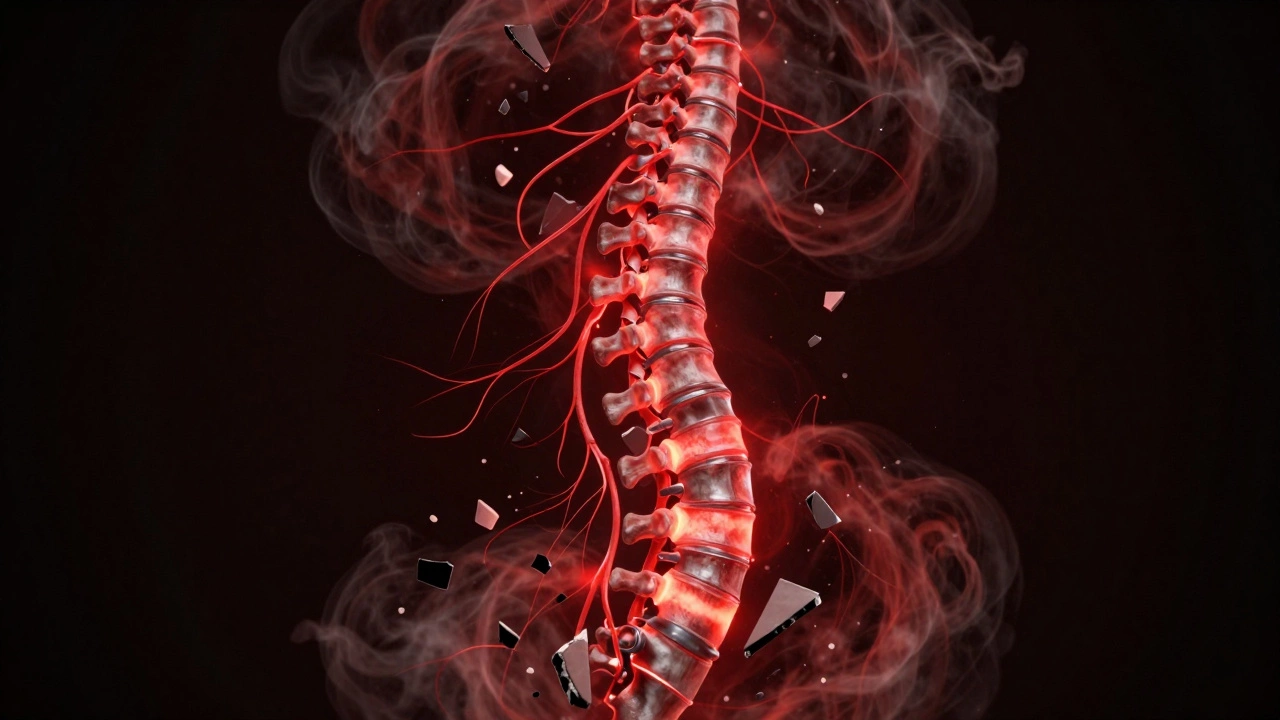
The pain here is deep, constant, and sharp. Unlike knee pain that comes and goes with movement, spinal fusion pain is always there. It’s not just the incision-it’s the inflammation around the nerves, the stiffness from being immobilized, and the fact that your spine is literally being held together with metal rods. Patients describe it as a deep, aching pressure that doesn’t let up, even with strong painkillers.
A 2023 study in the Journal of Neurosurgery: Spine tracked 1,200 fusion patients. Forty-two percent still reported moderate to severe pain at three months. Twenty-three percent said their pain was worse than before surgery. That’s not rare. That’s normal.
Why? Because nerves don’t heal fast. Even after the bones fuse, the surrounding tissues stay inflamed. And if you move wrong-like twisting too fast or lifting a grocery bag-you trigger a flare-up that can last days. Many patients say they’d rather have a broken leg than go through spinal fusion again.
Amputation: The Pain That Doesn’t Go Away
Amputation-removing a limb-isn’t just about losing a body part. It’s about losing a part of your identity. And the pain? It’s brutal.
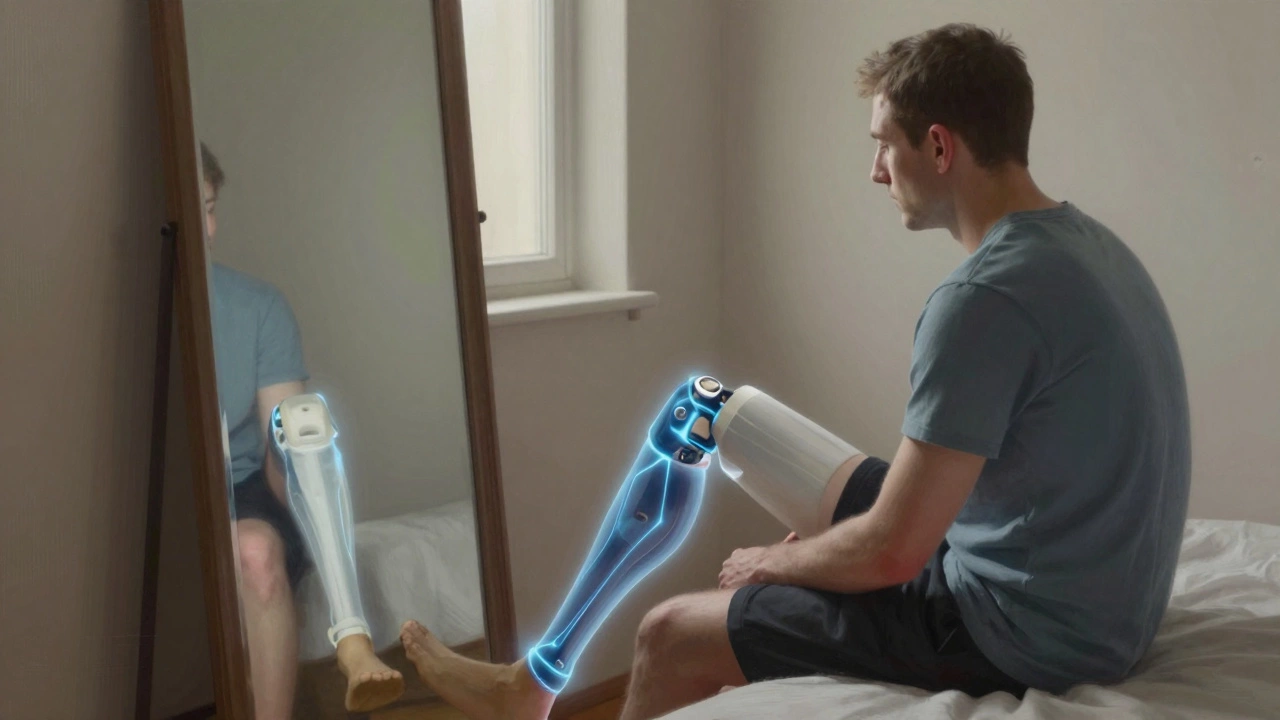
There’s the surgical pain, of course. But then comes phantom limb pain. That’s when your brain still thinks the leg or arm is there, and it sends pain signals to a limb that no longer exists. Up to 80% of amputees experience this. The pain can feel like burning, cramping, or electric shocks. It’s not imaginary-it’s real neurological activity.
In India, many amputations happen after diabetic complications or traumatic injuries. A patient from Hyderabad shared that after his below-knee amputation, he felt his toes curling for six months. He couldn’t sleep. He couldn’t sit still. Medications helped, but nothing erased it. He started using mirror therapy-staring at the reflection of his good leg-to trick his brain. It worked, slowly.
Studies from the Mayo Clinic show phantom pain can last years. Some patients need nerve blocks, antidepressants, or even spinal cord stimulators just to get through the day. The emotional toll is as heavy as the physical one. And unlike knee or spine pain, there’s no “fix.” You learn to live with it.
Why These Three Stand Out
What makes these surgeries uniquely painful isn’t just the surgery itself-it’s what happens after. All three involve:
- Major nerve disruption
- Long-term inflammation
- Loss of function that forces the body to relearn basic movement
- Pain that doesn’t follow the timeline you expect
Knee replacement hurts because you’re forced to move it before it’s ready. Spinal fusion hurts because you can’t move at all. Amputation hurts because your brain refuses to accept the change.
And here’s the thing: pain isn’t always tied to how big the surgery looks. A small procedure like a hernia repair can be less painful than a knee replacement. It’s not about the cut-it’s about the system your body has to rebuild.
What Helps? Real Recovery Strategies
If you’re facing one of these surgeries, knowing what to expect helps. But so does knowing what actually works.
For knee replacement: Start physical therapy the day after surgery. Don’t wait. Ice your knee 20 minutes every two hours. Elevate your leg. Don’t try to tough it out-ask for stronger pain meds if the first ones don’t help. Many patients regret not pushing harder for relief early on.
For spinal fusion: Sleep in a recliner for the first few weeks. Walking short distances every hour prevents stiffness. Avoid sitting for more than 20 minutes at a time. Use a lumbar support pillow. And don’t believe the myth that you need to stay completely still. Movement prevents scar tissue from locking everything up.
For amputation: Get a prosthetic fitting as soon as your doctor allows. Use mirror therapy, TENS units, or even virtual reality apps designed for phantom pain. Join a support group. Talking to someone who’s been there cuts the isolation-and sometimes the pain.
What About Other Surgeries?
Open heart surgery? It’s intense, but the pain is usually controlled well with epidurals and strong meds. Gallbladder removal? Minimal. C-section? Painful, but most women say it’s less than a spinal fusion. Even major cancer surgeries like pelvic exenteration, while life-altering, don’t always rank higher in pain scores than the top three.
Why? Because those surgeries often involve controlled pain management from the start. The top three? They’re not just about the procedure. They’re about the body fighting itself to heal.
Final Thought: Pain Isn’t a Weakness
It’s easy to hear someone say, “I had a knee replacement and it was fine,” and feel like you’re doing something wrong if you’re struggling. But pain is personal. It’s biological. It’s neurological. And it’s real.
If you’re preparing for one of these surgeries, don’t downplay your fears. Talk to your doctor about pain management before the operation. Ask for a pain plan-not just a pill. Ask about physical therapy, nerve blocks, or even counseling. Recovery isn’t just about healing the body. It’s about healing your sense of control.
And if you’ve been through one of these? You’re not alone. And you’re stronger than you think.
Is knee replacement the most painful surgery?
Knee replacement isn’t the most painful surgery overall, but it’s one of the most consistently reported as severely painful during recovery. Many patients say the pain peaks around day three, after nerve blocks wear off. It’s worse than many expect because the joint must be moved aggressively in physical therapy while still healing, causing deep aching and muscle spasms.
Why does spinal fusion hurt so long?
Spinal fusion hurts for months because it’s not just bone healing-it’s nerve tissue and ligaments rebuilding around metal hardware. Inflammation lingers, and nerves that were compressed for years take time to calm down. Movement restrictions also cause stiffness that feels like pain. Studies show over 40% of patients still have moderate pain at three months.
Can phantom limb pain be cured?
There’s no cure for phantom limb pain, but it can be managed. Treatments include mirror therapy, TENS units, antidepressants, nerve blocks, and even virtual reality. Many patients find relief through consistent therapy and support groups. The pain often lessens over time, but for some, it becomes a lifelong condition to manage.
How long does pain last after knee replacement?
Most patients feel significant pain for 2 to 6 weeks, with discomfort fading by 3 months. But mild soreness, especially with weather changes or overuse, can last a year or more. The goal isn’t to be pain-free-it’s to be pain-managed enough to walk, climb stairs, and live without fear.
Are there alternatives to these surgeries?
For knee replacement: weight loss, physical therapy, injections (like hyaluronic acid or steroids), or stem cell therapy may delay surgery. For spinal fusion: decompression surgery, epidural injections, or neuromodulation can help in some cases. For amputation: advanced wound care, antibiotics, or hyperbaric oxygen therapy might prevent it in diabetic cases. But if the damage is severe, surgery is often the only option to restore function or save life.
What Comes Next?
If you’re considering one of these surgeries, talk to your surgeon about pain expectations. Ask for a written recovery plan. Connect with others who’ve been through it. Pain isn’t something to ignore-it’s a signal. Listen to it. Manage it. And don’t let anyone tell you it’s just in your head.