
Knee Replacement Surgery Time Estimator
How This Works
Based on the article, surgery time varies due to:
- Complex deformities
- Scar tissue from previous surgeries
- Surgeon experience level
- Use of robotic assistance
Estimated Surgery Duration
Click calculate to see your estimate
Your expected time range based on factors above
Remember: A slightly longer surgery with perfect alignment often leads to better long-term outcomes than a rushed procedure.
When you’re considering a total knee replacement, one of the first questions that pops up is: how many hours does a total knee replacement take? It’s not just about the clock-it’s about what happens during those hours, why it varies, and what that means for your recovery. The short answer? Most total knee replacements take between 1 and 2 hours. But that number can stretch to 2.5 hours or more depending on your body, your surgeon’s approach, and any complications that come up.
What Happens During the Surgery?
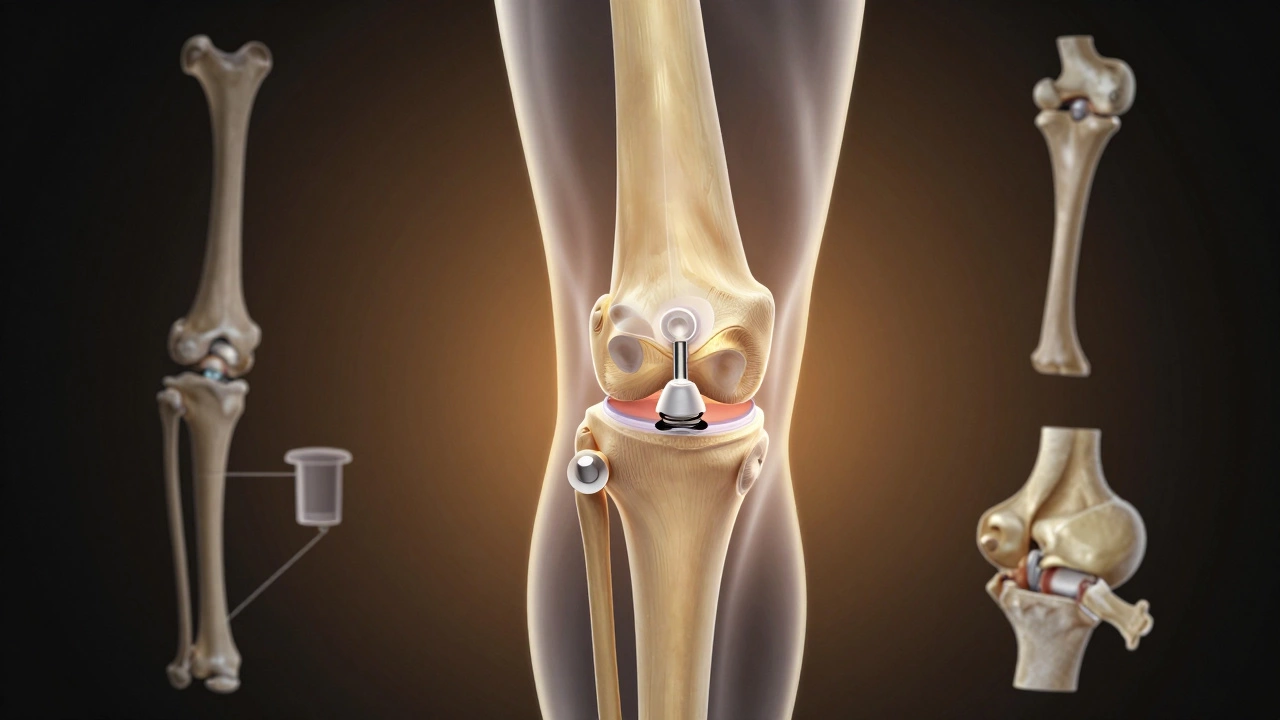
The actual cutting and replacing of the knee joint doesn’t take long. The real time is spent preparing the space, making sure everything fits perfectly, and checking blood flow and alignment. Surgeons start by making an incision along the front of the knee-usually 6 to 10 inches long. Then they remove the damaged cartilage and bone from the ends of the thighbone (femur), shinbone (tibia), and sometimes the kneecap (patella). After that, they fit metal components onto those bones and insert a plastic spacer between them to let the joint glide smoothly.
It sounds simple, but getting the alignment right is critical. Even a 2-degree tilt can cause early wear, pain, or instability. That’s why surgeons use guides, jigs, or computer-assisted navigation systems. Some hospitals use robotic arms to help place the implants with millimeter precision. These tools add 10 to 20 minutes to the procedure but often lead to better outcomes down the line.
Why Does Time Vary So Much?
Not every knee replacement is the same. A healthy 60-year-old with straightforward arthritis might get through surgery in 90 minutes. But someone with severe deformity, previous surgeries, or obesity could take longer. Here’s what adds time:
- Complex deformities: If your leg was bowed or knock-kneed before surgery, correcting that takes extra steps.
- Scar tissue: If you’ve had prior knee surgeries or infections, removing old scar tissue can double the time.
- Implant choice: Some newer implants require more precise positioning, which adds minutes.
- Surgeon experience: A surgeon who does 200+ knee replacements a year typically works faster without sacrificing accuracy.
- Complications: Unexpected bleeding, nerve irritation, or difficulty with anesthesia can pause the clock.
In a study of over 12,000 patients across U.S. hospitals, the average surgical time was 1 hour and 52 minutes. But the fastest 10% finished in under 1 hour and 20 minutes, while the slowest 10% took more than 2 hours and 30 minutes.
What About the Full Timeline?
Don’t confuse surgery time with total hospital time. The 1 to 2 hours you hear about is just the time spent in the operating room. Before that, you’ll spend 30 to 60 minutes being prepped-getting IVs, having your skin cleaned, being positioned on the table, and being put under anesthesia. After surgery, you’ll stay in the recovery room for another 1 to 2 hours while your vital signs stabilize and the anesthesia wears off.
So if someone tells you their knee replacement took 4 hours, they’re probably including prep, surgery, and recovery. The actual cutting and replacing? Still under 2 hours.
Does a Longer Surgery Mean Worse Results?
No-not necessarily. A longer surgery isn’t always a bad thing. In fact, studies show that surgeons who take a little extra time to perfect alignment and soft tissue balance often have fewer revision surgeries later. One 2023 analysis of 8,500 patients found that those with surgeries lasting over 120 minutes had a 17% lower chance of needing a second operation within five years.
What you want to avoid is surgery that’s unnecessarily long due to inexperience, poor planning, or technical errors. That’s when complications like infection, blood clots, or nerve damage become more likely. The key isn’t speed-it’s precision.
How Does This Compare to Other Joint Replacements?
Compared to other joint surgeries, knee replacements are on the longer side:
| Procedure | Average Duration | Range |
|---|---|---|
| Total Knee Replacement | 1 hour 50 minutes | 1h 15m - 2h 30m |
| Total Hip Replacement | 1 hour 30 minutes | 1h - 2h |
| Shoulder Replacement | 1 hour 45 minutes | 1h 15m - 2h 15m |
| Ankle Replacement | 2 hours | 1h 45m - 2h 45m |
Knee replacements take longer than hips because the knee joint is more complex. It doesn’t just hinge-it rotates, twists, and glides. Getting all those motions right requires more adjustments during surgery.
What Can You Do to Help Keep Surgery Time Short?
You can’t control the surgeon’s skill, but you can control your preparation:
- Get in shape: Stronger quadriceps and hamstrings mean less strain during surgery and faster recovery. Even 30 minutes of walking daily for 4 weeks helps.
- Stop smoking: Smoking slows healing and increases infection risk. Surgeons often delay surgery if you’re still smoking.
- Manage your weight: Every extra pound adds pressure on the joint and makes the surgery harder. Losing 5-10 pounds can make a measurable difference.
- Know your medical history: Tell your surgeon about every past surgery, infection, or allergy. Missing details can lead to surprises in the OR.
One patient I worked with in Bangalore lost 8 pounds and did daily leg lifts for 6 weeks before surgery. His procedure took just 1 hour and 18 minutes. He walked with a cane the next day.

What Happens After the Clock Stops?
Once the surgeon closes the incision, the real work begins-for you. Most people stand up and take a few steps with help within 24 hours. Physical therapy starts the same day or the next. You’ll be home in 1 to 3 days if everything goes smoothly.
But the 1 to 2 hours in surgery? That’s just the beginning. The next 6 to 12 weeks are where you rebuild strength and mobility. The surgery time is a snapshot. Your recovery is the whole movie.
When Should You Be Concerned About Surgery Time?
Most people don’t need to worry about how long the surgery takes. But if your surgeon says it will take over 3 hours without a clear reason-like a severe deformity or infection-you should ask why. Ask if they’ve done this type of case before. Ask about their complication rates. Don’t be afraid to get a second opinion.
Also, if you’re in a hospital that does fewer than 50 knee replacements a year, ask if they refer complex cases to higher-volume centers. Surgeons who do more of these procedures have better outcomes.
Remember: a quick surgery isn’t better if it’s sloppy. A slightly longer one with perfect alignment is worth every extra minute.
Is a 2-hour knee replacement considered long?
No, a 2-hour knee replacement is within the normal range. Most procedures fall between 1.5 and 2 hours. Even surgeries that last 2.5 hours aren’t unusual if there are complications or complex anatomy. What matters more than time is how well the implant is placed and how stable the joint feels after surgery.
Can a knee replacement be done in under an hour?
Yes, but it’s rare. Some highly experienced surgeons using minimally invasive techniques and robotic assistance can complete the procedure in under 60 minutes. These cases usually involve patients with straightforward arthritis, no prior surgeries, and good bone quality. Rushing isn’t recommended-precision matters more than speed.
Does the type of anesthesia affect surgery time?
Not directly. Whether you get general anesthesia or a spinal block doesn’t change how long the surgeon takes to replace the joint. But spinal anesthesia can reduce bleeding and speed up recovery, which may make the overall hospital stay shorter. Some surgeons prefer spinal blocks because patients wake up faster and have less nausea.
Why do some hospitals say the surgery takes 3 hours?
They’re likely including pre-op prep and post-op recovery time. The actual joint replacement rarely takes longer than 2.5 hours. But if you factor in time in the holding area, anesthesia induction, moving to the recovery room, and monitoring after surgery, the total time can easily reach 3 to 4 hours. Always ask what part of the timeline they’re referring to.
How long does it take to recover after a 2-hour knee replacement?
Recovery isn’t tied to how long the surgery lasted. Most people walk with a walker within 24 hours, use a cane by week two, and drive by week four. Full recovery-meaning no pain, full range of motion, and strength-takes 3 to 6 months. The surgery time doesn’t change this timeline. What matters more is sticking to your rehab plan and avoiding overuse in the first few weeks.
Final Thought
The number of hours a knee replacement takes isn’t something to obsess over. It’s not a race. What matters is that your surgeon has the skill to do it right, the experience to handle surprises, and the care to get the alignment perfect. A 90-minute surgery with perfect results beats a 120-minute one with misalignment every time. Ask questions. Do your prep. Trust the process. Your new knee will thank you for years to come.