Counseling vs Therapy Recommendation Tool
How long have you been experiencing these feelings?
Recently (Weeks to a few months)
A specific event triggered thisFor a long time (Months to years)
It feels like a recurring patternWhat is the primary source of your distress?
External / Situational
Job loss, breakup, grief, life changeInternal / Deep-seated
Childhood trauma, personality patterns, deep anxietyWhat is your main goal right now?
Practical Tools & Coping
I want strategies to handle immediate stressDeep Understanding & Change
I want to understand why I feel this way fundamentallyLoading...
Why this fits:
Explanation goes here.
Expected Duration:
Duration info.
Who to look for:
Professional type.
You’re feeling stuck. Maybe work stress is piling up, or a breakup has left you questioning everything. You know you need help, but then you hit a wall of confusing terms. Should you look for a counselor? A therapist? Is there even a difference? It’s frustrating because both promise relief, yet the labels feel like they belong to different worlds.
Here is the hard truth: in the real world, these words are often used interchangeably. But if you dig deeper into what happens inside that room, there are distinct flavors to each approach. Understanding this isn't just about semantics; it’s about finding the right fit for your specific problem. If you pick the wrong one, you might waste time and money on solutions that don’t scratch the itch you actually have.
The Core Difference: Focus and Depth
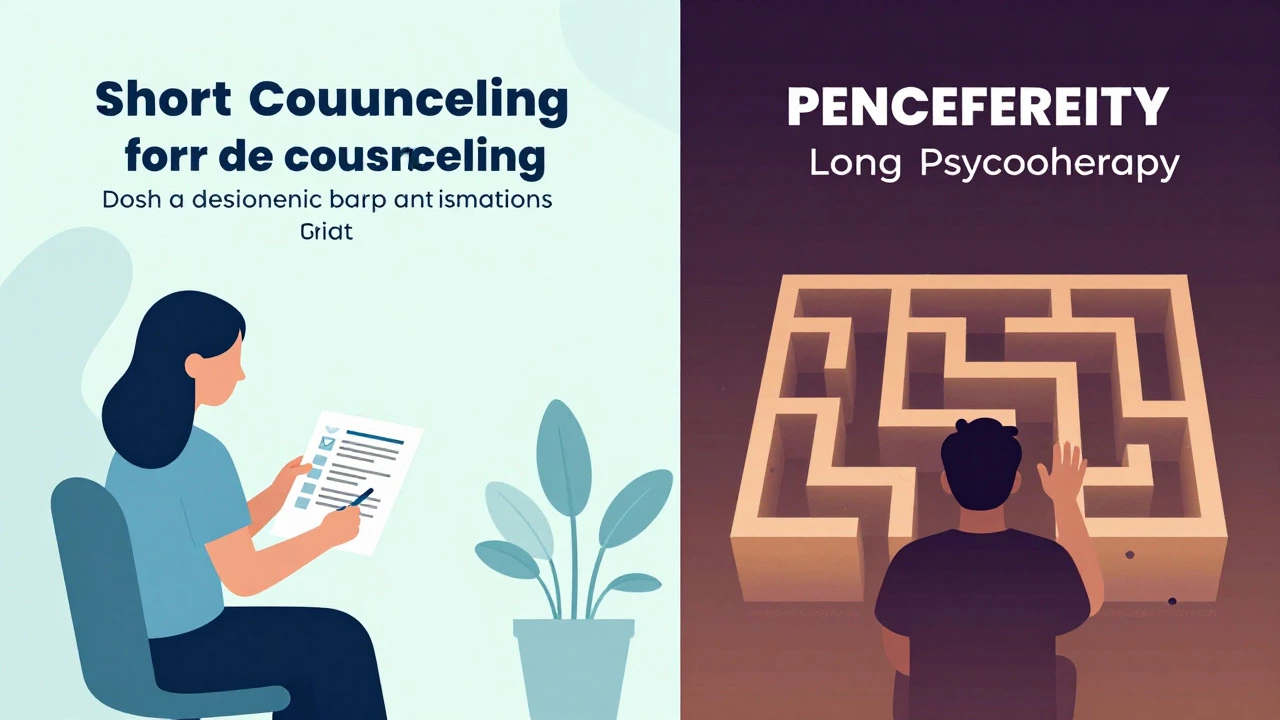
To understand which path to take, we first need to strip away the marketing jargon. Think of Counseling as a supportive process focused on solving specific, current problems and improving coping skills. It is usually short-term. You go in with a defined issue-say, anxiety about public speaking or grief after a loss-and you work on strategies to handle it. The counselor acts more like a coach or a guide, helping you navigate the immediate obstacle.
On the other hand, Psychotherapy, often just called Therapy, is a deeper, longer-term process aimed at exploring underlying patterns, past trauma, and personality structures. Instead of just putting out the fire, therapy asks why the house caught fire in the first place. It digs into childhood experiences, recurring relationship dynamics, and deep-seated emotional wounds. The goal here isn't just symptom management; it's fundamental change in how you think, feel, and relate to the world.
| Feature | Counseling | Psychotherapy (Therapy) |
|---|---|---|
| Duration | Short-term (weeks to months) | Long-term (months to years) |
| Focus | Present issues, specific problems | Root causes, past trauma, patterns |
| Goal | Coping strategies, decision making | Personality growth, behavioral change |
| Approach | Directive, structured | Exploratory, reflective |
| Best For | Grief, career changes, mild anxiety | Depression, PTSD, complex trauma |
When Counseling Makes Sense
Counseling is incredibly effective when you have a clear, identifiable trigger for your distress. Imagine you recently lost your job. You aren't necessarily broken; you're just navigating a life transition. A counselor helps you reframe your thoughts, build a new resume strategy, and manage the stress of unemployment. They provide tools you can use immediately.
It is also ideal for situational crises. If you are dealing with marital conflict, parenting struggles, or addiction recovery support, counseling offers a structured environment to learn communication skills and set boundaries. In India, where stigma around mental health is slowly fading but still present, many people prefer counseling because it feels less "medical" and more practical. It’s about fixing the leak, not rebuilding the plumbing.
- Grief and Loss: Processing the death of a loved one or a pet.
- Life Transitions: Marriage, divorce, retirement, or moving to a new city like Bangalore from a smaller town.
- Stress Management: Dealing with burnout at work or academic pressure.
- Relationship Issues: Improving communication with a partner or family members.

When Therapy is Necessary
Now, consider a scenario where the problem isn't a single event but a pattern. You keep choosing partners who treat you poorly. You feel anxious without knowing why. You have flashbacks to an incident from ten years ago. This is where psychotherapy steps in. It requires vulnerability and a willingness to sit with discomfort. Therapists use modalities like Cognitive Behavioral Therapy (CBT), Psychodynamic Therapy, or Dialectical Behavior Therapy (DBT) to uncover the subconscious scripts running your life.
If you suffer from clinical depression, bipolar disorder, or Post-Traumatic Stress Disorder (PTSD), counseling alone might not be enough. These conditions often require the depth and duration of therapy to rewire neural pathways and heal deep emotional scars. Therapy is not just talking; it’s active reconstruction of your self-narrative. It’s messy, sometimes painful, but ultimately transformative.
Decoding the Credentials: Who Are You Actually Hiring?
This is where things get tricky, especially in a diverse market like India. The title of the professional matters more than the label of their service. A "therapist" might just be a counselor with a fancy business card, and vice versa. Always check their qualifications.
In India, look for registered professionals. A Clinical Psychologist holds a Master’s degree (M.Phil or M.Sc) and is registered with the Rehabilitation Council of India (RCI). They are trained to diagnose and treat severe mental disorders. A Counselor might have a Master’s in Counseling Psychology or Social Work. While many counselors are highly skilled, they may not be qualified to treat severe psychiatric conditions.
Psychiatrists are medical doctors (MDs). They prescribe medication. Often, the best approach is a combination: a psychiatrist manages the chemical balance with meds, while a psychologist or therapist handles the talk therapy. Don't assume a "life coach" is a therapist. Life coaches are not licensed mental health professionals and should not be treating clinical issues.

How to Choose the Right Fit for You
So, how do you decide? Start by asking yourself three questions. First, is my problem recent and situational, or has it been lingering for years? If it’s recent, lean toward counseling. Second, am I looking for quick tools to cope, or do I want to understand my deep-rooted behaviors? Tools mean counseling; understanding means therapy. Third, what is my budget and time commitment? Counseling is generally cheaper and shorter.
Also, consider the cultural context. In many Indian families, discussing "childhood trauma" can feel taboo or overly dramatic. Starting with counseling for "stress" or "career guidance" can be a softer entry point. Once trust is built, you can dive deeper into therapeutic work if needed. There is no shame in starting small.
Common Pitfalls to Avoid
One major mistake people make is switching providers too quickly. Both counseling and therapy take time to show results. If you quit after two sessions because you didn't feel instantly better, you haven't given it a chance. However, if you feel unheard, judged, or unsafe after four to six sessions, it’s okay to leave. The therapeutic alliance-the bond between you and your provider-is the strongest predictor of success.
Another pitfall is expecting magic. Neither counseling nor therapy will solve external problems like poverty or a toxic boss. They equip you to handle those problems better. If you expect your therapist to fix your life for you, you will be disappointed. You have to do the homework. You have to face the fears. The professional is just the guide.
Is counseling covered by insurance in India?
Coverage varies widely. Many corporate health plans in India now include mental health benefits, covering a certain number of counseling or therapy sessions per year. Check your policy document for terms like "psychotherapy" or "mental health consultation." Government schemes like Ayushman Bharat have limited coverage for mental health services, primarily in hospital settings.
Can I switch from counseling to therapy later?
Absolutely. Many people start with counseling for immediate stress relief and realize they need deeper work. A good counselor will recognize this and refer you to a psychotherapist. It’s a natural progression, not a failure.
What is the cost difference between counseling and therapy in Bangalore?
In cities like Bangalore, counseling sessions typically range from ₹1,500 to ₹3,000 per hour. Psychotherapy with experienced clinical psychologists can range from ₹3,000 to ₹6,000 or more per session. Online platforms may offer lower rates, but quality varies. Always verify credentials regardless of price.
Do I need a referral from a doctor to start therapy?
No. You can directly book appointments with counselors and therapists. However, if you suspect a severe condition like schizophrenia or bipolar disorder, seeing a psychiatrist first for diagnosis and medication is advisable before starting talk therapy.
Is online counseling as effective as in-person?
Research shows that for many common issues like anxiety and mild depression, online counseling is nearly as effective as in-person sessions. It offers convenience and privacy, which is crucial in busy urban centers. However, for severe trauma or crisis intervention, in-person care is often recommended.